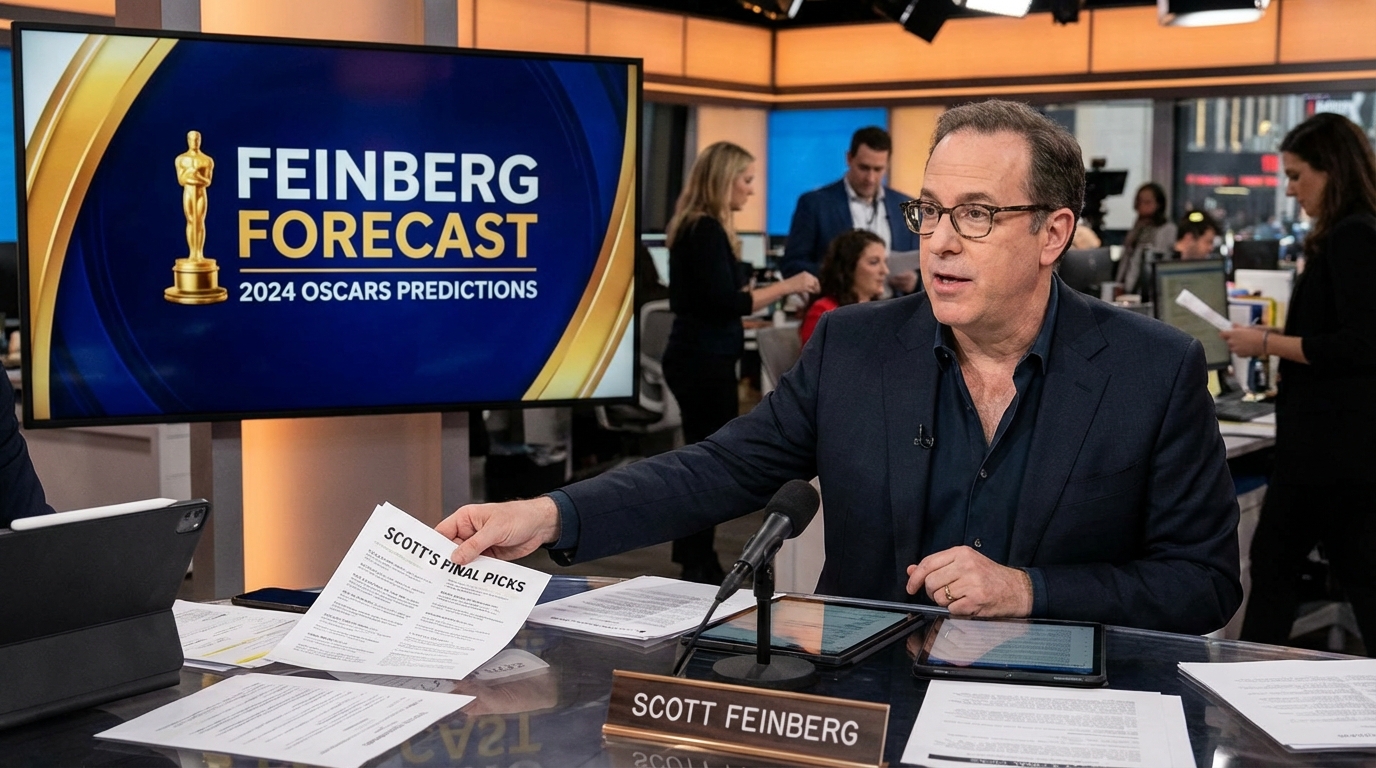
As the curtain rises on the 96th Academy Awards, the industry turns its eyes toward the definitive “Feinberg Forecast” from The Hollywood Reporter. Scott Feinberg’s final picks represent a synthesis of historical data, precursor awards, and deep-rooted industry sentiment, providing a roadmap for cinema’s most prestigious night.
The Evolution of the Feinberg Forecast
For over a decade, Scott Feinberg has served as the Executive Editor of Awards Coverage for The Hollywood Reporter, transforming the art of Oscar punditry into a rigorous, data-driven discipline. The “Feinberg Forecast” is not merely a list of personal favorites; it is an analytical deep dive into the psyche of the Academy of Motion Picture Arts and Sciences. To understand his final picks, one must first understand the unique methodology behind them. Feinberg spends months attending film festivals, hosting “Awards Chatter” podcasts, and speaking with anonymous Academy members to gauge the “temperature” of the voting body.
The complexity of predicting the Oscars has increased significantly in recent years due to the Academy’s expanding and diversifying membership. With over 10,000 voters now hailing from dozens of countries, the old “Hollywood old guard” consensus has been replaced by a more globalized perspective. Feinberg’s background and origins in the industry allow him to navigate these shifts, balancing the traditional influence of the Screen Actors Guild (SAG) and the Directors Guild (DGA) with the burgeoning impact of international voting blocs. His final picks are often seen as the “gold standard” because they account for the preferential ballot system used for Best Picture—a system that favors the film with the broadest consensus rather than just the most first-place votes.
Latest Developments and Final Category Picks
In his final forecast for the current season, Feinberg highlights a year dominated by the “Barbenheimer” phenomenon, yet his picks suggest a clear frontrunner in the most prestigious categories. For Best Picture, the consensus has solidified around Christopher Nolan’s “Oppenheimer.” Feinberg notes that the film’s unique combination of critical acclaim, massive box-office success, and technical mastery makes it an almost unstoppable force. He predicts that the film will not only win the top prize but also secure Christopher Nolan his long-awaited Oscar for Best Director. The momentum gathered from the Golden Globes, Critics Choice, and DGA awards has created a narrative of inevitability that is rare in modern Oscar history.
However, the acting categories present a more nuanced battlefield. In the Best Actress race, Feinberg identifies a historic “toss-up” between Lily Gladstone for “Killers of the Flower Moon” and Emma Stone for “Poor Things.” While Stone delivered a transformative, high-wire performance, Feinberg’s final lean toward Gladstone is rooted in the emotional resonance of her performance and the historical significance of her potential win as the first Native American woman to take home the prize. Conversely, the Best Actor race has seen a late-season surge. While Cillian Murphy remains the favorite for his internal, haunting portrayal of Robert Oppenheimer, Feinberg acknowledges the strong industry affection for Paul Giamatti in “The Holdovers,” suggesting that an upset, while unlikely, is not impossible.
The supporting categories appear more settled in the final forecast. Robert Downey Jr. is widely expected to win Best Supporting Actor for “Oppenheimer,” marking a career-crowning moment for one of Hollywood’s most beloved figures. Similarly, Da’Vine Joy Randolph’s performance in “The Holdovers” has swept every precursor award, making her the safest bet of the night in the Best Supporting Actress category. Feinberg’s analysis suggests that while the “Oppenheimer” sweep is likely, the Academy still finds ways to spread the wealth in the screenplay and craft categories, where films like “Anatomy of a Fall” and “The Zone of Interest” are poised to make their mark.
Impact and Significance of the Forecast
The significance of Scott Feinberg’s final picks extends far beyond simple “office pool” bragging rights. In the ecosystem of Hollywood, these predictions act as a feedback loop. Studio executives, publicists, and consultants use the Feinberg Forecast to measure the effectiveness of their multimillion-dollar “For Your Consideration” campaigns. A high ranking or a “frontrunner” status in the final forecast can influence the betting markets and, more importantly, the narrative of the telecast itself. When a pundit of Feinberg’s stature declares a race “over,” it can sometimes lead to a “bandwagon effect” among undecided voters who want to be on the right side of history.
Furthermore, the Feinberg Forecast sheds light on the changing values of the Academy. By highlighting the strength of international features like “The Zone of Interest” in major categories, Feinberg reflects a shift toward a more “cinephile” Academy. This impact is significant because it validates the Academy’s efforts to diversify its ranks. When the forecast accurately predicts wins for non-traditional or international films, it reinforces the idea that the Oscars are truly becoming a global celebration of cinema rather than just a domestic trade show. Feinberg’s professional standing ensures that his observations on these trends are taken seriously by the power players in the industry.
Future Outlook and the Changing Awards Landscape
Looking ahead, the nature of Oscar campaigning and prediction is undergoing a fundamental transformation. The rise of streaming platforms and the shortening of theatrical windows have changed how voters consume films. Feinberg has noted that the “traditional” campaign trail—filled with physical screenings and lavish luncheons—is being supplemented, and sometimes replaced, by digital outreach and social media narrative-building. This shift suggests that future iterations of the Feinberg Forecast will need to incorporate digital sentiment analysis and streaming viewership data to remain accurate.
Moreover, the Academy’s new representation and inclusion standards (Aperture 2025) will begin to play a more significant role in how films are greenlit and campaigned. Feinberg’s future picks will likely have to account for these systemic changes, as the “Best Picture” criteria become more intertwined with the industry’s social responsibilities. As we look toward the 97th Oscars and beyond, the Feinberg Forecast will remain an essential tool for navigating the intersection of art, commerce, and politics. While the movies themselves change, the human desire to predict, analyze, and celebrate the pinnacle of achievement in film remains constant, and Scott Feinberg continues to be the most reliable guide through that complex journey.