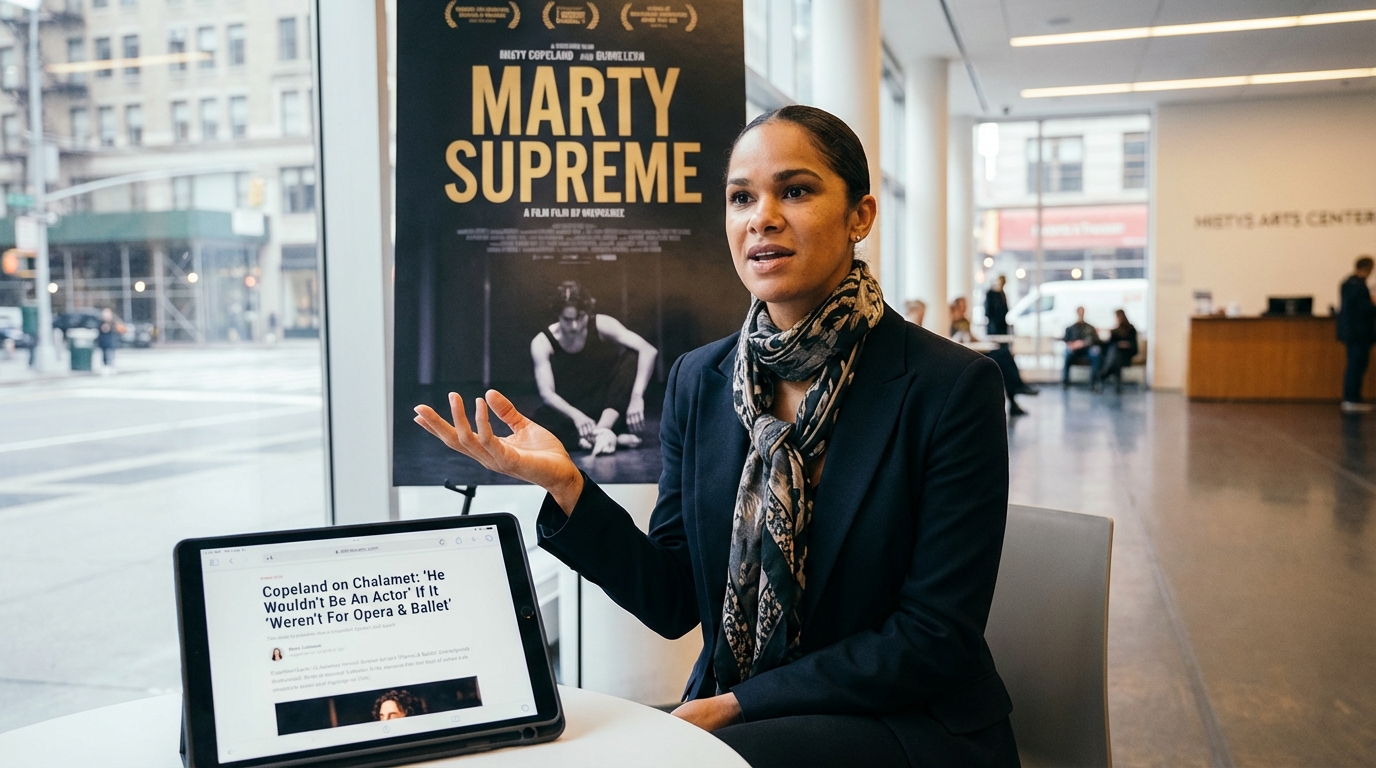
Renowned ballerina Misty Copeland recently sparked a fascinating conversation about the intersection of classical arts and modern cinema while promoting the upcoming film “Marty Supreme.” She asserted that Timothée Chalamet’s prowess as an actor is fundamentally rooted in his exposure to and appreciation for the disciplined worlds of opera and ballet.
Background and Origins
Misty Copeland is a name synonymous with breaking barriers. As the first African American female principal dancer with the American Ballet Theatre, she has spent her career redefining what it means to be a classical performer in the 21st century. However, her latest venture takes her from the stage to the producer’s chair. Copeland serves as an associate producer on “Marty Supreme,” a highly anticipated A24 production directed by Josh Safdie. The film is a fictionalized account inspired by the life of Marty Reisman, a professional ping-pong player known for his flamboyant style and incredible skill during the mid-20th century.
The project marks a significant collaboration between the world of elite athletics and high-caliber filmmaking. Casting Timothée Chalamet as the lead was a move that generated instant buzz, but for Copeland, the choice was about more than just star power. Chalamet, a graduate of the Fiorello H. LaGuardia High School of Music & Art and Performing Arts—the legendary “Fame” school in New York City—has always been vocal about his respect for the performing arts. This shared background in New York’s rigorous artistic training ground provided the foundation for Copeland’s observations regarding Chalamet’s unique approach to his craft.
Latest Developments
In recent promotional interviews for “Marty Supreme,” Copeland delved into the specifics of Chalamet’s performance and his work ethic on set. She made the bold claim that Chalamet “wouldn’t be the actor he is” if it weren’t for the influence of opera and ballet. According to Copeland, these classical disciplines instill a sense of rhythm, spatial awareness, and emotional precision that are often missing in actors who lack such foundational training. She noted that Chalamet possesses a “musicality” in his movements, which is particularly vital for a role that involves the fast-paced, rhythmic nature of professional table tennis.
Copeland highlighted that Chalamet’s preparation for “Marty Supreme” involved more than just learning how to handle a paddle; it involved understanding the “choreography” of the sport. In her view, his ability to internalize complex physical sequences and translate them into a compelling narrative performance is a direct result of his proximity to the world of dance and classical music. She observed that he approaches a scene much like a dancer approaches a variation—with a keen eye for tempo, breath, and the physical expression of internal conflict. This perspective sheds new light on Chalamet’s career trajectory, suggesting that his success in diverse roles, from “Dune” to “Wonka,” is supported by a silent, classical framework.
Impact and Significance
The significance of Copeland’s comments lies in the bridge they build between “high art” and mainstream entertainment. For too long, ballet and opera have been viewed as niche or elitist pursuits, disconnected from the gritty reality of modern filmmaking. By identifying these forms as the bedrock of a Hollywood superstar’s talent, Copeland is advocating for the continued relevance of classical training. Her insights suggest that the discipline required to master an aria or a pirouette creates a level of mental and physical fortitude that is universally applicable to any performing art.
Furthermore, this endorsement from a figure as influential as Copeland elevates the “Marty Supreme” project beyond a standard sports biopic. It positions the film as a study in movement and style, emphasizing the “art” within the “athlete.” The film’s focus on Marty Reisman—a man who treated ping-pong as a theatrical performance—aligns perfectly with Copeland’s philosophy. By framing Chalamet’s acting through the lens of ballet and opera, the production highlights the importance of physical storytelling. This approach could potentially influence how future biopics are cast and directed, placing a higher premium on actors who can convey character through movement as much as through dialogue.
Future Outlook
As “Marty Supreme” moves closer to its release, the industry is watching closely to see if the “musicality” Copeland described translates to the screen. If the film succeeds in capturing the rhythmic elegance of table tennis through Chalamet’s performance, it could validate Copeland’s theory and encourage a more holistic approach to actor training. We may see a resurgence of interest in classical performing arts among young actors who wish to emulate Chalamet’s versatility and depth. The connection between the grace of the ballet stage and the intensity of the film set is a narrative that both Copeland and Chalamet seem eager to champion.
Looking ahead, this collaboration may be just the beginning for Misty Copeland’s career in film production. Her ability to spot the intersection of different artistic mediums suggests she will continue to bring a unique, movement-oriented perspective to cinema. For Timothée Chalamet, these comments reinforce his status not just as a “movie star,” but as a highly trained artist who respects the lineage of his craft. As audiences prepare to see him take on the role of a ping-pong legend, they will now be looking for the subtle echoes of the opera house and the ballet studio in every move he makes on the court. The resulting synergy between sport, cinema, and classical art promises to make “Marty Supreme” one of the most intellectually and visually stimulating releases of the year.